
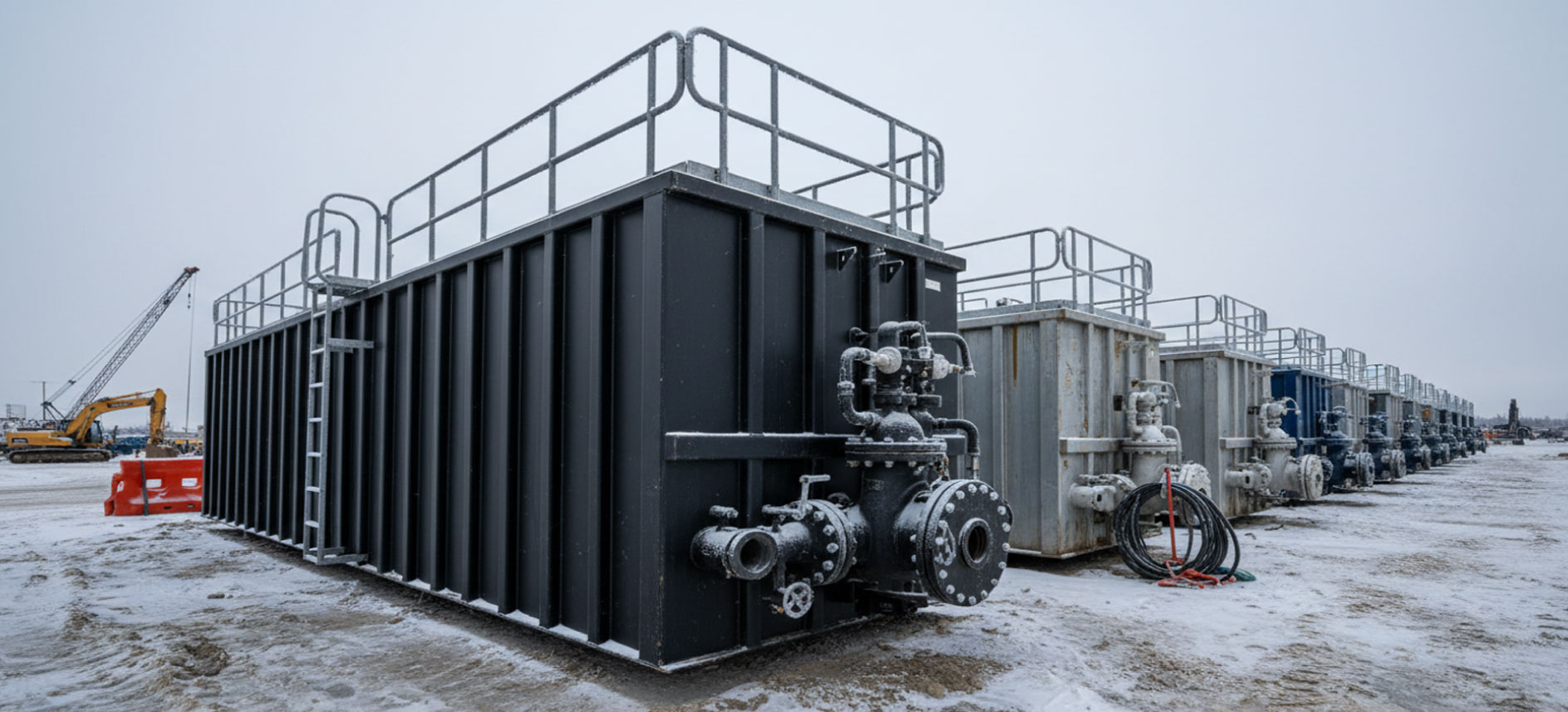
Keeping Fracking Fleets Running Through Winter
“Winter is coming,” quips Mike Johnson, Warren Electric Heating Technologies Sales Engineer. “And it’s not just a Game of Thrones line. It’s the cold reality for crews trying to keep equipment moving when temperatures plummet.”
Across North America’s major shale formations, fracking operations face a simple truth: cold oil doesn’t flow. Engines, compressors, pumps, and other equipment rely on lubrication oil that must meet specific viscosity requirements. If the oil becomes too viscous, equipment can’t start, and crews face costly delays. That’s where lube oil heaters come in.
“Think of it like a diesel truck in the winter,” Johnson says. “That engine wouldn’t start without a block heater. It’s the same concept, just bigger and more critical on a well pad.”
When Cold Costs Money
In the fracking industry, time is money. Crews operate on tight schedules, aiming to complete a well efficiently before moving to the next. Any delay at startup can ripple across operations. If a lube oil heater is undersized or fails, oil takes longer to reach specification. On sites where multiple heaters share a single sump, it only takes one failure to delay the entire system.
Johnson emphasizes, “No one wants to waste time waiting on or replacing failed equipment. That’s why reliability isn’t an option, it’s a requirement.” If the heaters aren’t ready, the fleet isn’t ready.
Remote locations magnify these challenges. Equipment is trailer-mounted and constantly moved across rough terrain. Draining lube oil for maintenance is messy, environmentally risky,
and time-consuming. In short, crews need electric heaters that work as hard as the rest of the fleet.
Engineering for the Field
Electric lube oil heaters have become standard for fracking because they provide precise and controllable heat. Warren Electric takes that baseline and designs for the oilfield’s realities.
Specifically, our over-the-side (OTS) heaters are ideal for this application. Johnson explains, “You can install or remove the heater from the oil sump without draining a drop. That’s time saved and cost avoided.”
Warren Electric has also designed lube oil heaters at roughly 30% lower than API’s 15 WPSI limit for critical operations like fracking. “Lower watt density keeps the sheath temperature down,” Johnson notes. “It protects the oil and the heater, reducing thermal shock and preventing coking.” The terminal housing is epoxy-potted, which keeps elements dry even after extended immersion or periods of non-use.
The construction is deliberately rugged. Flanges are ¼-inch steel while intermediate terminal housing and riser pipe are SCH-40 steel. “Fracking fleets take a beating. Your equipment has to withstand rough roads, trailer movement, and harsh weather—and our heaters can handle it,” Johnson says.
Our collaboration with customers on heater sizing and configuration further improves MTBF (Mean Time Between Failures). Multiple heaters may be required in a sump to better match the load or provide installed redundancy.
One of Warren Electric’s customers, a major provider of electric-powered frac fleets, sees the benefits firsthand. Installed on their fleet, our OTS heaters allow maintenance crews to service heaters without draining the oil. That means no cost for new lube oil and no environmental risk from draining it on-site. The lower watt density and epoxy-sealed elements extended service life and kept oil clean. “Every minute saved on maintenance is a minute you can use fracking a well,” Johnson adds.
And Warren’s service doesn’t end at the point of sale. To help protect our customers from downtime, we can carry sufficient inventory or hold completed stock to reduce lead time.
Safety, Compliance, and Move Toward Electrification
Warren heaters meet NEC and API 614 standards and current units satisfy most operational requirements. Johnson highlights another advantage: “Even with relaxed regulations [in the US], operators are moving toward cleaner, quieter sites. Electric heaters fit right into that trend. They give you reliability without the emissions you’d get from diesel or combustion heating.”
Electric heat is becoming increasingly accepted across well-site applications traditionally powered by combustion systems. Noise, emissions, and sustainability pressures are driving operators to electrify their fleets—and heaters are part of that shift. Trailer-mounted turbine generators from OEMs provide site-wide electricity using natural gas instead of diesel. “Operators aren’t just powering pumps,” Johnson says. “They’re monitoring turbine performance, and soon, every heater, pump, and auxiliary will be part of that predictive maintenance ecosystem.”
Future control systems will likely include current monitoring, resistance measurement, and automatic bake-out cycles, flagging potential failures before they happen. “It’s about keeping the fleet running and keeping downtime from ever becoming an issue,” he adds.
Why Warren
Warren Electric Heating Technologies blends scale with agility. We can meet the production volume needs of national oilfield operators, but flexible enough to respond to custom requirements and tight schedules. For operators preparing fleets for winter or transitioning to electrified well sites, Warren lube oil heaters are a dependable, field-ready solution.
Johnson puts it simply: “We understand the pressures of the field. We know speed and performance matter. That’s why we design heaters that work for the long run.”