
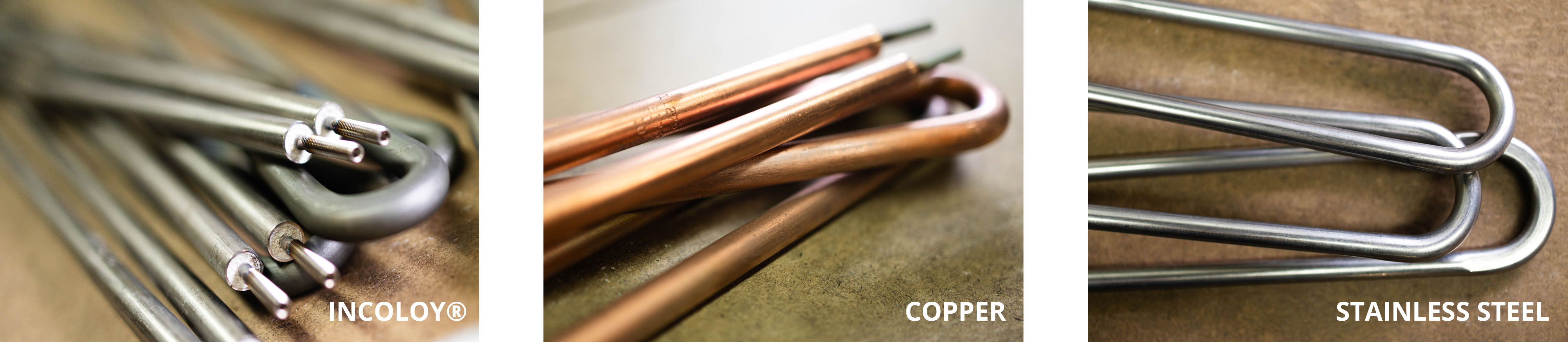
Every choice in heater design can impact the integrity of your process and equipment. Using an incompatible sheath material for your specific fluid can even lead to heater failure. At Warren, we’re here to help you succeed and make informed decisions for your business.
Here’s your guide to element sheath material selection:
FLUID COMPATIBILITY:
Ensure the element sheath material is compatible with the process fluid to reduce risks of corrosion, contamination, or premature wear. Copper is a non-ferrous metal, so copper heaters have high corrosion resistance for highly reactive fluids and acids. For mild corrosive oils, specific grades of stainless steel (e.g., 316L) heating elements work best.
TEMPERATURE RANGE:
Each application demands a specific temperature tolerance. Choosing an element sheath material designed to withstand operational temperatures keeps your heater running smoothly, especially in high-temperature or long-duration applications. Incoloy heaters are ideal for high-temperature applications (up to 1500°F), offering good oxidation and carburization resistance.
THERMAL CONDUCTIVITY:
High thermal conductivity is key for efficient heat transfer. Materials that optimize heat transfer allow for faster response times and energy savings. While copper elements offer excellent thermal conductivity, their usage is limited to lower temperatures (up to 400°F).
MECHANICAL PROPERTIES:
The element sheath material should maintain its integrity under themechanical stress and pressure variations of your application. For example, stainless steel heaters are known for their durability in more turbulent applications.
Choosing the right material for your heater will safeguard your equipment and industrial process. For specific guidance on your application, reach out to us at Warren. We’re here to help you find the best match.